When people start looking into massage therapy school in Costa Rica, they aren’t just interested in what the curriculum includes, or how close the beach is, or how long the program lasts.
They want to know what daily life is like when living in a new country, surrounded by classmates, trying to keep up with an accelerated program, and adjusting to a place that feels both invigorating and unfamiliar.
At the Costa Rica School of Massage Therapy (CRSMT), that lived experience tends to leave a strong impression on students, providing a more layered experience than people might expect. It is beautiful, yes. But it is also rigorous, vulnerable, communal, and deeply immersive.
As CRSMT alumni Caroline Manning, ‘25, puts it, studying there was “one of the hardest things that I’ve challenged myself with,” but also “one of the most life-giving things that I’ve ever done.”
That combination—challenge and renewal, intensity and beauty—is really the heart of what this experience seems to be.
Key Insights
- Studying massage therapy in Costa Rica is immersive and intense: students describe long class days, clinic hours, and a fast-moving academic pace that quickly becomes an all-in experience.
- What makes the experience distinctive is the setting: students move through demanding coursework while living in Sámara, where the beach, nature, and slower rhythm of daily life can help them reset between classes and studying.
- The close residential setup helps shape the experience, turning classmates into a real support system and making the program feel communal rather than isolating.
- Alumni describe the experience as personally transformative, saying they left not just with training, but feeling more confident, grounded, and changed by the experience overall.
What Does Day-To-Day Life Actually Feel Like?
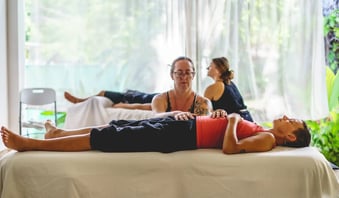
The reality of being a student at Costa Rica School of Massage Therapy is that it is not a leisurely study-abroad experience. It is a full, demanding routine.
The CRSMT program, located in Samara on Costa Rica’s Pacific coast, is a 4.5-month intensive experience designed for total immersion.
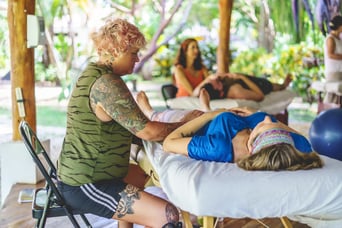
As Summer Cardoza, ‘25, explains, days at CRSMT were structured and steady: wake up, have coffee, head to class, stay in class until around 3 or 3:30 in the afternoon, and then on clinic days continue on into the evening. Once the clinic started, students could be in clinic from about 3:45 to 8:30 at night once or twice a week.
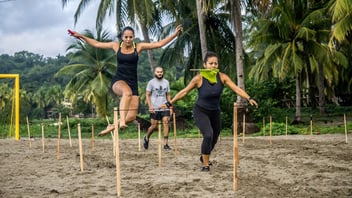
“Free time” did exist, but it often looked different than people imagine. It might mean jumping in the pool, going to the ocean for a little while, then coming back to study. It might mean sharing food with classmates, taking a breather, and then reviewing material for the next exam. The rhythm, in Cardoza’s experience, was consistent: class, clinic, studying, repeat.
Manning echoes that same intensity. The schedule challenges you because you “eat, sleep, breathe massage therapy and anatomy and kinesiology and all these different things.” More than just being busy, she says, the program forces you to learn how you learn and how you manage yourself under pressure.
That is an important distinction. The difficulty is not only about time. It is also about what the experience asks of you personally. You are not just memorizing information. You are being asked to stay grounded, keep moving, and keep growing in a highly immersive environment.
Yet both Manning and Cardoza found the experience transformative.
Manning contrasts her life in Minneapolis—where recovery after a long day might look like crashing on the couch—with CRSMT, where a study break could mean floating in the ocean for 15 minutes or sitting under what she called the “big grandmother tree” on campus to feel grounded. Cardoza remembers looking out over the expanse of nature, marveling at it’s beauty and allowing those moments to act as a soothing escape from any stress she was feeling in the moment.
What Is It Like To Live In Sámara While You Study?
If the program gives structure to the experience, Sámara seems to give it texture.
Both Cardoza and Manning describe the town as welcoming, with friendly locals and the day-to-day feeling of being in a place where people greeted you, shared space with you, and created a strong sense of community.
Cardoza fondly recalls the roadside food, fresh fruit—so good as to make the fruit back in the United States taste oddly bland by comparison—and a kind of grounded, hardworking warmth that made the environment feel alive.
To Manning, Sámara presented a “vibe” that allowed you to arrive and be accepted. Even though she had spent time in Costa Rica prior to attending CRSMT, arriving in Sámara for school felt different to her. She arrived at sunset and one of the first things she saw was a fire dancing show on the beach, which gave the town an immediate sense of magic.
While such a welcoming environment does not remove the challenge of school, both alumni admit it changes the experience of moving through it.

What Does Campus Life Actually Feel Like?
If Sámara shapes the broader atmosphere, campus life seems to shape the day-to-day sense of belonging.
Room setup, a more private or a shared-house feel, and what daily life looks like is built around close community.
Cardoza calls the campus a “small community” where her studio apartment—one with air conditioning that provided relief from the heat—often turned into a study space where classmates gathered. Around the student houses is a central pool, which became part of everyday life.
She describes borrowing kitchen items, helping other classmates when needs arose, and texting in group chats about practical little needs—who had a pan, who needed something, who was around.
“It had a very community vibe,” she says, “and I loved it.”
Manning admits she was initially hesitant about entering a close community and knew there would be little distance in this type of environment. Students living near one another, studying together, and sharing that kind of closeness could, she knew, feel intense.
But that closeness is what allowed relationships to deepen quickly. Since each student was dealing with something new, there was a natural level of vulnerability and the result was that people really saw one another. Support was often close at hand simply because someone was nearby and understood what you were going through.
That does not mean communal living was always perfectly easy, but because of the structure of the program, people had to work through them. In that way, living there felt less like temporary travel and more like real community life.
And according to both alumni, those bonds have lasted.
What Is It Like To Adjust To The Climate And Physical Environment?
Cardoza is straightforward about the heat and humidity. Coming from the Northeastern part of the U.S., she expected Costa Rica to be warm, especially since she attended during the rainy season, but was still surprised by the intensity.
She admits that it took her a few weeks to acclimate, especially learning in open-air conditions and doing hands-on work while feeling hot and sticky.
But she also talked about how that same environment became part of what made the experience memorable. When she felt uncomfortable, she could stop, look around, and remember that she was learning in a place surrounded by trees, tropical fruit, and lush growth.
Manning’s relationship to the environment was even more visceral. She described the beach not just as scenic, but as something she actively leaned on.
If she had been studying for hours, she could walk a minute and a half to the beach and sit in the sand. If she was stressed after an exam, she would go into the water and let it wash that anxiety away.
For her, the ocean became part grounding tool—part ritual, part challenge. She said she would make herself float longer than she was comfortable, push a little past fear, and let the experience open something up in her.
Both describe a scene that may seem foreign to many: full moons lighting up the whole beach “like the lights were on,” dark nights where you could see the Milky Way, and even a time when the planets aligned and could be pointed out in the sky.
What Is The Academic Experience Really Like?
It is demanding.
Cardoza admits that one of her biggest concerns before starting at CRSMT was the educational load. Even though she had recently finished a bachelor’s degree program, she still worried about the amount of material and the pace of the program. But the admissions staff prepared her well by being transparent from the start: this was going to be intense.
Manning describes the academic challenge in similar terms. She said the courses are hard, the schedule is hard, and the whole experience pushes you to edges where you have to figure out how to adapt.
But the rigor is only part of the story. The other part is support.
When Cardoza found herself stressed about exams or overwhelmed, she could reach out to staff members who would calm her down and help her reset. Whether teaching assistants or tutors, there was a general sense that the staff were prepared for students to struggle at points and fully invested in helping them to succeed.
For Manning, the program pushed her in ways that made her discover new confidence in herself intellectually. She had struggled with school in the past and did not think of herself as especially intelligent, but at CRSMT she found that she “could not get enough of the education.” She felt invited to open up to different ways of learning, and that changed how she understood herself.
It is an example of what “support” can look like beyond just tutoring. It can also mean being in an environment that helps you access a version of yourself you did not fully trust before.
How Does The Experience Change You?
Both Cardoza and Manning admit to being a “different person” after their experience at the Costa Rica School of Massage Therapy.
Cardoza arrived at the school stressed, anxious, and prone to overthinking. Over time, however, she became more trusting, more open, and more emotionally light. By the end of the program, she felt “much happier,” “healthier,” and felt as if she could do anything.
Manning says she noticed a change in herself fairly early—by the end of the first quarter—and that she became open to whatever that transformation was asking of her. The experience challenged her academically, socially, and personally, with the community, the instructors, and even the land around her helping move her through those challenges faster than she had in other parts of her life.
When she returned home, people noticed it physically. They told her she carried herself differently. She walked differently. That shift was visible.
For both, the CRSMT experience wasn’t just about acquiring new skills and launching a new career as a massage therapist. It changed how they move, think, relate, and carry themselves in every part of their lives.
So what is it really like to study massage therapy in Costa Rica?
The honest answer is that there are a lot of things at once.
It is full days and heavy studying. It is humidity, ocean air, and walking back from class still thinking about anatomy. It is group chats about kitchen supplies, late conversations with classmates, and the relief of realizing other people are struggling with the same things you are. It is the beauty of a beach town, but also the discipline of showing up every day to do difficult work.
It is not a vacation. But it may be, for the right person, the kind of immersive reset that changes more than a résumé.
If someone is seriously considering it, Cardoza believes the best bet may be to “stop overthinking and take the leap.” Manning feels similarly. While she admits the immersive experience of CRSMT isn’t for everyone, “it is scary, but worth it” for those who are ready to commit.
Want to learn more about CRSMT?