Career dissatisfaction doesn’t always arrive all at once. It often starts quietly…and slowly.
The work leaves you drained. The travel, meetings, deadlines, screens, or constant pressure start to take more and more of a toll. The career that once made sense no longer reflects the kind of life you want to live.
It’s a realization that can be unsettling, especially if you have spent years building experience in a traditional professional pathway. But questioning your current career does not mean you have failed. In many cases, it means you are paying closer attention to what your work is costing you—and what you want your next chapter to feel like.
For many, massage therapy is a part of that answer. It offers a path rooted in service, presence, human connection, and hands-on healing. It can also appeal to anyone who wants to move away from work that feels abstract or disconnected and toward work that feels more personal and grounded.
Key Takeaways
- A massage therapy career change often begins when a “good” job no longer feels aligned, sustainable, or meaningful.
- Massage therapy can appeal to burned-out professionals because it offers more human-centered, service-oriented, hands-on work.
- Making a major career change requires practical planning around money, family, travel, time away, and support systems.
- CRSMT’s immersive format can help career changers step away from distractions and fully focus on building a new professional identity.
- Massage therapy training can open the door to many paths, including private practice, nervous system regulation, trauma-informed bodywork, craniosacral therapy, and other healing modalities.
When a “Good” Career No Longer Feels Right
Elizabeth James was a part of the corporate world. She worked as a business and technology consultant—she traveled, went to client sites, was involved in project leadership and software implementation, and dealt with the kind of high-pressure environment many corporate professionals would recognize.
“I was on the road a lot, on a plane half the month probably, off at client sites putting in software, running projects, leading teams of people to build something,” she says. “In hindsight—high stress. But at the moment, I was just doing it.”
So, when she finally made the decision to trade her consulting career for something new, it wasn’t about making an impulsive decision. It was about listening to her inner self—something needed to change.
For James, the COVID-19 pandemic created the space she needed to see her career differently. When travel stopped and she began working from home, a realization set in—she did not miss the road in the way she expected.
“I came down close to the end of 2020 and I realized, wow, I don’t think I want to do this anymore,” she recalls. “I don’t think I want this type of work. And I had no idea what was next. Massage had not even been a thing. I just knew: no more of this.”
That may sound familiar to many professionals who are considering a massage therapy career change. The first step isn’t necessarily the exact one towards the future, but instead may simply be the honest recognition that the present no longer fits.
Why Massage Therapy Appeals to Career Changers
People are drawn to massage therapy for different reasons—health and wellness; flexible, independent employment; the chance to work with the body rather than spend every day in a corporate or screen-based environment.
For James, the appeal came partly from wanting to serve people in a more meaningful way.
After leaving consulting, she gave herself time to explore. She tried bartending and loved the change of pace. She also considered culinary school, but realized it might lead her into another untenable environment.
“I was like, wait a minute, culinary school—all the chefs are stressed out,” she says. “Why would I put myself in another stressful line of work?”
James knew she was interested in wellness, but she was not drawn to the traditional healthcare system. So, she began exploring alternative health fields such as herbalism and acupuncture before massage therapy emerged as a possibility.
“There was something about wanting to serve people in a more real way,” she says, “versus in the corporate world, [where] I was just making companies more money or helping them save more money.”
Massage therapy offered a different kind of work: personal, embodied, service-oriented, and connected to healing. For professionals who feel disconnected from the impact of their current work, that shift can be powerful.
What it Takes to Step Away From the Familiar
Even when a new path feels right, leaving an established career can be frightening. Career changers almost always have practical concerns about:
- Income
- Savings
- Family responsibilities
- Time away from home
- Travel logistics
- Fear of making the wrong choice
James was 45 when she found the Costa Rica School of Massage Therapy (CRSMT). Knowing already that she did not want to spend years in school, the immersive structure of CRSMT appealed to her. And she loved to travel, so the idea of studying in Costa Rica felt exciting rather than intimidating.
But the decision didn’t just impact her. She had a fiancé (now husband) and one child at home, so the choice to attend a five-month massage therapy program in Costa Rica was something they needed to make together.
“It was really about bringing my husband along with me on this journey,” she says. “This is a mutual decision kind of thing.”
They talked through the decision carefully, looking at the practical realities from multiple angles. Eventually, he told her something that helped her trust the direction she already felt drawn toward: “You can’t not do this.”
For prospective students considering an immersive experience such as the one offered at CRSMT, it’s important not to ignore reality. Enrolling requires planning, support, and honest conversations with the people your decision may affect.
Doubt is normal. Logistics matter. But uncertainty does not automatically mean the answer is no.

How Immersive Massage Therapy Training Can Support a Career Change
One reason CRSMT appealed to James was the opportunity to fully immerse herself in training. She had compared other schools, including in-person options closer to home, but CRSMT stood out.
“I was all-in from the moment I saw CRSMT and explored the website,” she recalls. “It was a big ‘yes’ compared to all the other schools I considered.”
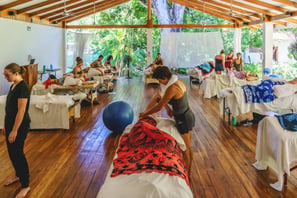
For career changers, immersion can be especially valuable as, instead of trying to stretch training around an already-demanding life, students step into an environment designed for focus. The work is not easy, and anyone expecting a retreat-like experience will likely be disappointed. Massage therapy school requires study, discipline, vulnerability, and personal growth.
However, CRSMT prepares students well before arrival, according to James, who remembers online meetings where the prospective students could ask questions, hear from staff, and better understand what to expect.
Once there, James found herself adjusting not only to classes, but also to community life, shared housing, daily rhythms, and a new environment.
The structure helped. So did the feeling of being supported.
At the same time, the experience gave her space to build a rhythm that worked for her. She studied early in the morning, took walks on the beach, jumped in the ocean, went to class, and learned how to balance the intensity of training with the environment around her.
“I really loved the freedom to figure out how to make it feel good and flow,” she says. “It doesn’t have to be all study.”
That balance can be part of what makes immersive training transformative. Students are learning a new trade, practicing a new way of structuring their days, relating to others, and understanding the kind of life they want to build.
The Rigor and Growth of Learning Massage Therapy
For professionals leaving corporate careers, massage therapy may seem like a complete departure from their previous work. And in many ways, it is.
But prior skills often carry over in unexpected ways.
James’s background as a project leader helped her approach the intensity of CRSMT’s curriculum. She was used to managing complex problems, planning ahead, and holding multiple tracks of work in her mind. Those skills became useful when she encountered the academic demands of massage therapy training.
The anatomy and physiology coursework, in particular, required focus.
“Every day is a new chapter…or more than a chapter…and then you have an exam every week,” she says.
To keep up, James developed a study rhythm. As a morning person, she woke up between 4 and 5 a.m. to study. She used flashcards, identified when her brain worked best, and adjusted accordingly.
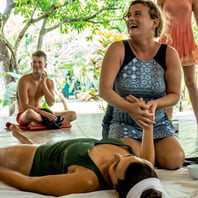
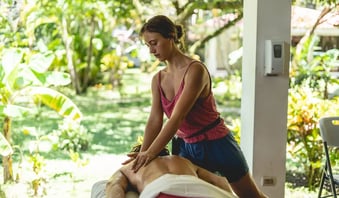
While massage therapy is hands-on, it is not casual. Students learn anatomy, physiology, kinesiology, technique, client communication, boundaries, ethics, and how to work safely with the human body.
They also learn through practice. James remembers that, during the early stages of bodywork, everyone in the class was tentative. Students were learning touch, flow, pressure, positioning, and how to avoid overworking the body.
At first, she says, the experience was very mind-focused. Over time, once the foundational skills became more familiar, the art of the work began to emerge.
“I got to figure out how I do it first, and then I can flow,” she says. “Learning the rules so you can break the rules.”
That progression is part of becoming a massage therapist. Students move from memorizing and performing techniques toward developing presence, sensitivity, and judgment.
Learning to Hold Space for Others
One of the deeper revelations when it comes to massage therapy training is realizing that the work is not only technical. Massage therapists see clients who may be carrying stress, pain, grief, trauma, tension, or emotional exhaustion in the body.
James lauds CRSMT for preparing students to be ready for experiences that cannot be fully understood just from reading a textbook, including what happens to those who experience emotional responses during bodywork.
“Emotional releases are a thing in body work,” she says, explaining that some clients may cry during the session. “There was real life learning there that you can’t teach from a book.”
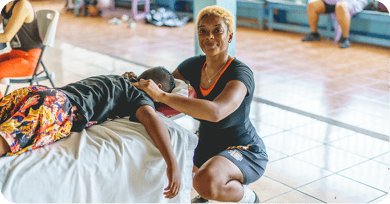
For many career changers, part of the appeal of massage therapy is to be present with another person in a vulnerable setting. It requires skill, professionalism, compassion, and the ability to create a safe environment.
CRSMT normalized those moments, James says, and helped students understand how to hold space for one another.
“It’s such a safe space,” she says. “We hold such a safe container for each other down at the school.”
That experience shaped the direction of her work after graduation. Today, James has her own private practice and has continued studying somatic experiencing, trauma touch work, nervous system regulation, and craniosacral therapy.
She says massage therapy opened the door to areas of healing work she did not fully know existed before attending CRSMT.
“Massage was just the door opening for me,” she says.
Building a Meaningful Practice After Graduation
For many massage therapy students, their career path will lead to a position at a spa working in soothing environments with different clients. But others are interested in pursuing different opportunities.
After graduating, James knew she wanted to open her own practice. Her business background helped her feel comfortable taking that step, and she was drawn early on to subtle, nervous-system-oriented modalities rather than more aggressive bodywork.
“I knew that’s the kind of therapist I’d be,” she says. “I wouldn’t be like, ‘Go big or go home, no pain, no gain.’ That’s not a thing.”
Since opening, her practice has continued to evolve. Traditional massage remains part of her work, especially because it is what many clients already understand. But she has also been building awareness in her community around trauma healing, nervous system regulation, somatic work, and craniosacral therapy.
For James, the difference between her former career and her current work is profound.
“It’s like night and day,” she says. “I feel like a different human in a lot of ways. I feel softer. I can relate with anybody. I have more compassion and empathy.”
No massage therapy career looks exactly the same. Some graduates work in spas or wellness centers. Some build private practices. Some focus on sports massage, clinical work, prenatal massage, trauma-informed bodywork, craniosacral therapy, or other modalities. Some begin in one setting and evolve into another over time.
The larger point is that massage therapy can create a professional foundation that keeps unfolding. For career changers who are looking for work that can grow with them, that matters.
A Massage Therapy Career Change Can Be a Return to Purpose
Leaving a corporate or traditional professional path behind can feel risky. But staying in work that no longer fits can carry its own cost.
A massage therapy career change is not only about changing jobs. For many people, it is about returning to a sense of purpose, presence, and connection. It is about building a career around helping others feel better in their bodies and lives.
For James, CRSMT helped make that transition possible. It gave her the structure to learn, the immersion to focus, the community to feel supported, and the foundation to keep growing after graduation.
“If I had talked myself out of it, oh man,” she says. “I can’t imagine where I’d be.”
If you are burned out, unfulfilled, or beginning to wonder whether your current career still works for you, massage therapy may be worth exploring.
CRSMT’s immersive massage therapy program can help you understand what it takes to make that transition and whether this path aligns with the life and work you want to create next
Want to learn more about CRSMT?