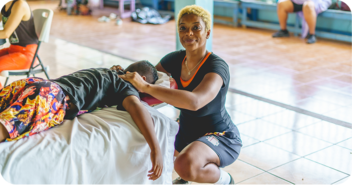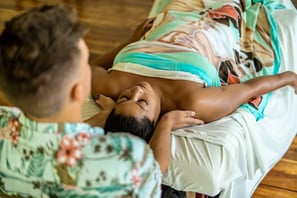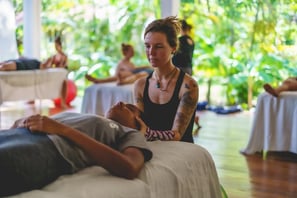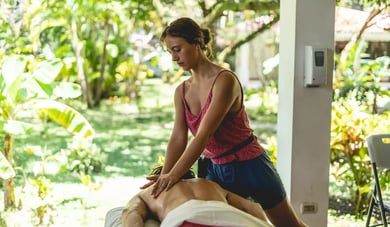
Changing careers later in life is more common than ever, especially for adults in search of meaningful, flexible work that allows them to make a difference in other people’s lives.
If you’re in your 40s, 50s, 60s, or even beyond, a second-act career in massage therapy can offer purpose, connection, and the joy of working with your hands. A full-time, immersive program like the one offered by the Costa Rica School of Massage Therapy (CRSMT) can provide an ideal path for those ready to step into a new chapter and build the skills needed to thrive in this rewarding field.
Key Insights
- It’s never too late to begin a meaningful, hands-on career. Massage therapy offers purpose, flexibility, and connection—qualities many people seek later in life.
- Your life experience becomes a strength. Skills from previous careers—communication, empathy, body awareness, and professionalism—directly enhance your success as a massage therapist.
- An immersive program like CRSMT can accelerate your transition. Full-time study in a supportive, community-oriented environment allows you to step away from old routines and fully commit to your next chapter.
- Second-career therapists are in demand. With strong job growth and flexible work options, graduates can enter the field with confidence and begin shaping a career that fits their lifestyle.

Why Massage Therapy Appeals to Career-Changers Later in Life
People often pursue massage therapy in midlife because they’re looking for work that matters. Paul Amenson knows this firsthand. Now 65, he completed the CRSMT program after transitioning out of careers in acupuncture and the restaurant industry.
“This was one of the best decisions of my life,” Amenson insists. “I really enjoy the work that I do.” His journey shows that it’s not only possible to begin this path later in life, but that it’s often deeply rewarding.
A Career That Uses Your Hands and Your Heart
Massage therapy consistently ranks as a meaningful and satisfying profession, with the U.S. Bureau of Labor Statistics projecting 15% job growth through 2034—much faster than average.
For Amenson, it was about returning to something tactile and human: “I really wanted to get back to using my hands again… I wanted a new challenge.”
Your Life Experience Becomes a Strength
Many older students bring with them skills honed over the lifespan of a professional career—skills such as communication, empathy, body awareness, and intuition, all of which enhance their ability to work with clients.
Amenson’s years in restaurant service, for example, unexpectedly shaped his approach.
“Waiting tables has a diagnostic technique to it,” he explains. “You look at someone’s bearing and tone of voice and try to suss out what they need. That proved really helpful.”
His background in acupuncture and Tai Chi also supported his ability to feel and understand the body.
Common Concerns About Starting Massage Therapy Later in Life
Are you wondering whether you’re too old, too out of practice, or just not strong enough to take on a new career as a massage therapist? You’re not alone. Most second-career therapists deal with the same anxiety.
“Am I physically strong enough?”
Technique matters far more than raw strength. CRSMT teaches body mechanics that allow therapists of all ages to work safely and effectively.
“You learn not to use your fingers and thumbs, but your wrists, forearms, and the heels of your hands… how to make a part of your body fit where you need to go,” says Amenson.
“What if I’m rusty academically?”
Many wonder if, having been out of school for many years, the work will be too much to handle. Amenson describes the phenomenon as “brain rust” and took steps to ensure he was preparing his mind to step back into the classroom by spending time “studying before I went so I could excel.”
This preparation helped tremendously, he insists.
“Can I afford this and make it work logistically?”
Returning to school later in life is an investment, so choosing the right format matters. For Amenson, as he began to review possible schools, the chance to step away from his old routine and dive into a new professional identity became more and more attractive.
“I was looking at doing something intensive,” he explains. “What about doing an adventure and [something] intensive?”
CRSMT’s full-time program provided that opportunity: a complete reset in a beautiful, supportive environment built for students who want to dedicate themselves fully to learning. The experience is designed to give you the space to focus, grow, and transform without distractions.
Why CRSMT’s Immersive Program Works
The CRSMT program, located in Samara on Costa Rica’s Pacific coast, is a 4.5-month intensive experience designed for total immersion.
This format is ideal for career changers who want high-quality training without dragging the process out over a year or more.
A Structured Environment That Helps You Learn Quickly
Because everyone in the program is fully committed, the pace is fast but also deeply supportive.
“That first week or two, they just had a number of different ways we'd interact in… different size groups—sometimes like five, sometimes two,” recalls Amenson. “It just helped us introduce ourselves to each other, [and] get a feel of each other.”
A Life-Reset Disguised as Professional Training
Studying massage abroad creates space to step away from old routines and truly focus. CRSMT’s campus environment—nature, ocean, small community—gives students the room to grow personally and professionally.
A Supportive, Welcoming Community for All Ages
Even though Amenson was older than most classmates, he found the environment encouraging, not isolating. Cohort bonding happens quickly, and age diversity is embraced.
Living in shared housing was an adjustment, but he came prepared for an adventure.
“It was a shock going from my own one-bedroom apartment to sharing a small bungalow with one [roomate],” he remembers, “but I knew I needed to be flexible…and it worked out great.”
Building Confidence and Skill Throughout the Program
Massage school is both academic and experiential. You’ll learn anatomy and physiology, proper body mechanics, and hands-on technique.
For many students—especially those who haven’t practiced bodywork before—confidence builds one skill at a time. For instance, Amenson remembers feeling cautious at first about draping. However, over time he became more confident and comfortable.
The real reward for Amenson came as he was able to rediscover the tactile intelligence he’d garnered over his years working in acupuncture and Tai Chi.
“It was really nice rediscovering my hands and learning how to use them again.”
Launching Your Career After Graduation
Graduates of CRSMT are well-prepared to take the MBLEx exam and begin practicing.
Massage therapists are in high demand, especially in wellness centers, spas, integrative clinics, and private practices. Many therapists choose to work part-time, making this an ideal career for retirees or those seeking gradual transition.
“I knocked on four doors and was offered two jobs,” Amenson recalls, about his initial job search in Washington state.
Is Massage Therapy Right for You? Advice from Someone Who’s Done It
If you’re completely new to massage therapy, Amenson recommends easing in. But if you feel drawn to the work, trust that impulse. Many people discover massage therapy is exactly the purposeful, life-giving career they’ve been searching for, and Amenson believes CRSMT is the perfect place for many to begin that journey.
“I definitely highly recommend the school… the quality of education is really good, and the setting is fun.”
Choosing the Right School for This Next Chapter
If you’re serious about starting a career in massage therapy later in life, the school you choose matters. CRSMT is known for:
- A rigorous, immersive curriculum
- Highly qualified instructors
- A stunning, supportive learning environment
- Strong graduate outcomes
- An experience that fosters both personal and professional transformation