Massage therapists come from all different backgrounds, for all different reasons.
Some may be drawn to massage because it offers meaningful, hands-on work. Others are likely looking for a career that helps people feel better, move better, or manage stress in a more supportive way.
But no matter the motivation, every future therapist is asking one fundamental question: what kind of training will help me get to where I want to go?
The first step in answering that question is deciding which massage therapy school is right for you. According to the U.S. Bureau of Labor Statistics, massage therapists typically complete postsecondary education that combines classroom study with hands-on experience, and most states regulate the profession through licensure or certification requirements.
In other words, far from simply being a “box to check,” school is fundamental to how you work with clients, prepare for licensing, and enter the field with confidence.
As you compare massage therapy programs, here are 10 questions worth asking before you enroll.
Key insights
- The right massage therapy school should prepare you for licensure, not just graduation.
- Accreditation, curriculum, hands-on practice, and MBLEx preparation all matter.
- A strong program< /span> should teach science, technique, ethics, communication, business, and self-care.
- Student support, housing, cost, schedule, and learning environment can all shape your experience.
- Schools such as CRSMT offer one example of how an intensive, hands-on program can combine professional preparation with a supportive study abroad model.
1. Is the School Accredited or Recognized by Reputable Massage Therapy Organizations?
Ensuring a school is accredited and recognized professionally is essential to understanding whether it is held to outside standards for quality and accountability. They are also important factors when it comes to licensure, transferability, and employer confidence.
As you research schools, check which organizations accredit or recognize the program. You should also ask whether that recognition matters in the state or country where you plan to practice.
The Costa Rica School of Massage Therapy (CRSMT), for example, is accredited by the Commission on Massage Therapy Accreditation (COMTA) and is currently the only COMTA-accredited massage therapy study abroad program in the world. CRSMT is also an NCBTMB Assigned School and a member of the American Massage Therapy Association and the Alliance for Massage Therapy Education, meaning the school’s program and massage therapy education are recognized by several established organizations in the massage therapy field.
Accreditation alone does not guarantee that a school is the right fit for you, but it is an important place to start.
2. Will the Program Meet Licensing Requirements Where I Plan to Practice?
Massage therapy licensing requirements vary by state and location. As such, the right program for one student may not automatically meet the needs of another.
Before choosing a school, it is helpful to identify where you hope to practice after graduation. That will allow you to determine whether the hours, coursework, and exam preparation of a particular program align with that location’s requirements.
You should also verify requirements directly with the appropriate licensing board instead of relying on general claims.
CRSMT graduates are eligible for licensing in most of the United States and many other places around the world. While such broad eligibility provides excellent long-term career flexibility and growth potential, it remains vital to plan your path carefully.
If you already know where you want to live and work after school, it’s important to bring that information into your admissions conversations early.
A good school should help you ask the right licensing questions before you commit.
3. How Many Hours of Training Does the Program Offer, and Can I Add Hours if Needed?
Training hours and licensure requirements are interconnected, so understanding what a program offers is an important first step in deciding where to attend.
Not all licensure requirements are identical, as some locations may demand more hours than others. Some students may also want to take advantage of additional education to strengthen their skills or expand where they are eligible to practice.
When comparing programs, ask how many hours are included, what those hours cover, and whether the school offers a path to add more if needed.
CRSMT’s massage therapy curriculum includes 600 to 800 hours of accelerated training, with options to expand in increments—625, 640, 660, 700, 725, 750, or 800 hours. This allows you to tailor hours to meet different state licensing requirements, where that is applicable.
Such flexibility can be useful, but more hours are only valuable if they are built around meaningful coursework, hands-on learning, and professional preparation.
4. Does the Curriculum Balance Science, Technique, Ethics, Business, and Self-Care?
While massage therapy is fundamentally centered on meaningful, hands-on work, that doesn’t mean it isn’t deeply rooted in science and professional knowledge.
Therapists need to understand how the body functions, recognize when massage may be inadvisable or require modification based on a person’s symptoms, medications, or health history, and document sessions appropriately. They also must learn how to effectively communicate with a variety of clients while also protecting their own physical and mental wellbeing.
Massage therapy programs generally include instruction in anatomy, physiology, kinesiology, and pathology. Some will also touch on non-science subjects, such as business and ethics. Since real-world massage therapy requires making informed decisions with real clients and other partners, touching on a variety of topics is important to ensure a full educational experience.
CRSMT’s curriculum, for instance, includes such variety:
- Anatomy and physiology
- Kinesiology
- Western massage techniques
- Pathology
- Ethics
- Communication
- Hydrotherapy
- Business development
- Clinical practicum
- Board preparation
The school’s educational philosophy also emphasizes self-care, mindfulness, movement, and career longevity.
When comparing programs, remember that a strong school should help you become not only a skilled therapist, but a sustainable one.
5. How Much Hands-On Practice Will I Get with Real Clients?
Learning how to become a skilled massage therapist cannot be accomplished through lectures alone. Students need supervised practice, instructor feedback, and experience working with different bodies.
They also need to understand how to set and meet the goals of different clients who may have vastly different needs.
When considering massage therapy school, you should inquire as to how their hands-on training is structured. Some helpful questions would include:
- Will I practice only with classmates, or will I also work with members of the public in a supervised clinic?
- How often will instructors observe me?
- What kind of feedback will I receive?
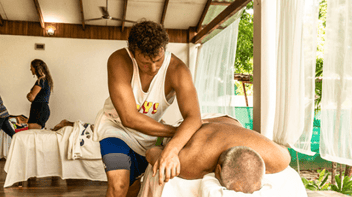
At CRSMT, supervised student clinic experience is a main part of the program, giving students the opportunity to practice client interviews, assessment, and treatment planning, as well as subjective, objective, assessment, and plan (SOAP) charting, contraindication awareness, and professional communication.
Confidence in one’s own skills often grows through repetition. A quality program will ensure that you are not encountering clients for the first time after graduation. You should already have practiced how to listen, adapt, communicate, and work safely while in a structured, learning environment.
6. Does the Program Prepare Students for the MBLEx or Other Licensing Exams?
Massage therapists will often be required to pass the MBLEx or another licensing exam before practicing in their particular location. A strong massage therapy school should not leave you to figure that process out on your own.
Put exam preparation—practice tests, review sessions, study strategies, and support for understanding the exam process—at the top of your list of priorities for any program being considered. That can help you determine whether exam preparation is treated as an afterthought or built into the curriculum.
As an example, board preparation for the MBLEx, including review sessions, practice tests, and study strategies designed to help students prepare for the licensure exam, is a fundamental part of CRSMT’s program.
Such attention to detail is the hallmark of a good program, where knowledge is built steadily so the exam feels like the next step, not a separate mountain to climb.
7. What Kinds of Massage Modalities Will I Learn?
To be a good massage therapist, it is important to meet the client where they are.
Some clients want relaxation. Others want support with tension, recovery, mobility, stress, or general wellness. That is why it helps to choose a program that introduces you to more than one approach.
The National Center for Complementary and Integrative Health, which describes massage therapy as the manipulation of soft tissues to help manage health conditions or enhance wellness, lists several of the different massage styles, including:
- Swedish/classical massage
- Sports massage
- Clinical massage
- Shiatsu
- Thai massage
- Hydrotherapy
When considering where you should enroll, make sure the school is offering different modalities and that students learn how to apply each of them safely.
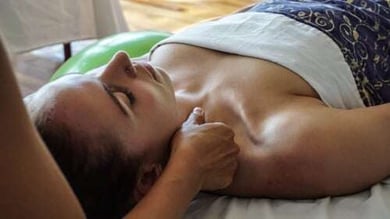
At CRSMT, for instance, therapeutic relaxation, deep tissue, myofascial release, trigger point therapy, positional release, craniosacral therapy, and other techniques are all a part of the curriculum, giving students a breadth of options.
You may not know exactly what you want to specialize in right away. But exposure to multiple modalities can help you discover what kind of therapist you want to become.
8. What Student Support and Community Experience are Available?
The fastest program, or the one closest to you, is not always the ones that will provide the best learning experience. That can be especially true for those making a major career change or considering an intensive program.
Support outside the classroom is an important aspect of a strong program. Are instructors accessible? Is there a strong student community? If relocation is required, what housing options are available? How does the school support students during a demanding schedule?
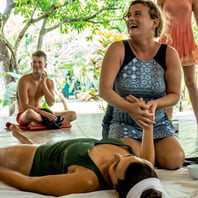
For students drawn to an immersive study abroad model, CRSMT’s student accommodations are part of the overall experience. Students can live on campus near Samara Beach, with access to shared housing, common spaces, kitchens, Wi-Fi hotspots, weekly housekeeping, linens, and nightly security.
Different environments will suit different students. Some may feel more comfortable staying closer to home, but for many, an immersive study abroad opportunity can offer a level of support, connection, and ability to focus that makes the adventure worthwhile.
9. What is the Full Cost of Attendance, and What Financing or Scholarship Options Exist?
Cost is a major factor for most students, and understandably so. But when comparing massage therapy schools, it’s important for you to consider more than just tuition.
Are books, supplies, clinic materials, board preparation, housing, transportation, or student fees included? Are there payment plans, scholarships, or refund policies? What additional expenses should be expected?
A strong program should be upfront about its full cost of attendance and provide clear ways for students to navigate their investment. At CRSMT, the school provides transparent details regarding tuition costs and financing opportunities. It also outlines exactly what is included in that investment beyond intensive instruction: curriculum, MBLEx preparation, instructors, classroom and clinic supplies, textbooks, practical clinic use, airport transportation from Liberia, and a graduation celebration.
Your budget is going to play a major role in what school you ultimately choose. But to understand what the investment truly means, it’s imperative to understand whether the value matches your goals.
10. Does the School’s Format Fit My Life, Learning Style, and Career Timeline?
Finally, determine whether the program format actually fits your life.
For some, a traditional local program that unfolds over a longer period of time is the right choice. Others want an immersive, accelerated experience that allows them to focus fully and enter the field sooner.
There is no right or wrong answer. What matters is whether the structure matches your responsibilities, learning style, finances, and career timeline.
Those considering CRSMT will find an immersive, accelerated academic calendar with three start dates per year. Students can complete the full accelerated program in 4 to 6 months or split the program into two 2- to 3-month segments.
For those who want a focused path into massage therapy, such a schedule may be a strong fit. Such students are often looking to pause all outside distractions and, instead, focus fully on their massage therapy studies.
But it is important for you to be honest with yourself. The right program should feel challenging, but realistic. It should stretch you without setting you up to feel constantly behind.
Making the Right Choice for You
Becoming a massage therapist is about more than learning techniques. It is about preparing to work safely, ethically, and confidently with real people.
That is why choosing a school matters so much. The right program should help you understand the body, practice with support, prepare for licensure, communicate with clients, care for yourself, and begin building the kind of career you want.
For students looking for an intensive, hands-on massage therapy education in a supportive study abroad environment, CRSMT offers one example of what a well-rounded program can look like. Its model combines COMTA-accredited training, clinical practice, MBLEx preparation, flexible hour options, student housing, and an immersive setting in Costa Rica.
Want to learn more about CRSMT?