.png?width=390&height=228&name=Rectangle%2048(1).png)
When imagining a career as a massage therapist, one picture comes to mind: a quiet spa room, soft music, dim lighting, and a steady schedule of appointments focused on relaxation.
And for many, that path remains meaningful and rewarding. But it is by no means the only path.
Massage therapists work in a wide range of environments, including spas, wellness centers, fitness facilities, medical and rehabilitation-adjacent settings, clients’ homes, local events, and private practices. Many are also self-employed.
Some work with professional athletes or for collegiate sports teams. Others work on cruise ships, corporate offices, or even with performing artists.
Rather than a narrow career trajectory, completing massage therapy training can open up numerous opportunities, and getting the right education, such as the intensive programs offered by Costa Rica School of Massage Therapy (CRSMT) can set you down a pathway that leads well beyond the traditional spa.
Key Takeaways
- Where can massage therapists work? Massage therapists can work in spas, wellness centers, fitness facilities, health practitioner offices, clients’ homes, private practices, corporate wellness settings, events, resorts, cruise ships, and educational settings. Many massage therapists are also self-employed.
- Spa work can be a strong and fulfilling career path, but it is not the only option for graduates who want more autonomy, variety, or specialization.
- Sports massage, therapeutic bodywork, and mobile massage can allow therapists to support clients with movement, recovery, discomfort, and wellness goals.
- Entrepreneurship gives massage therapists the opportunity to shape their own services, client relationships, work environment, and professional identity.
- CRSMT’s immersive, hands-on training can help students explore different modalities and prepare for a flexible massage therapy career
Massage Therapy Careers Don’t Have to Start and End at the Spa
Spa work is the most visible and well-known career path for massage therapists, and can provide consistency, an established client base, and a relaxing environment in which to work.
But for some, the spa just isn’t the right fit.
Morgan Rojas learned that early in her career. After graduating from CRSMT, she worked at a spa and found that, while she formed friendships with the therapists she worked with, the structure of the work did not match the goals she had for herself as a therapist.
“I think the impact that I wanted to have was not going to be successful in that setting,” she says.
In a traditional spa setting, appointments can feel compressed and clients may come in primarily to relax, not necessarily to talk through movement patterns, pain, training habits, or body awareness. For Morgan, that made it harder to have the kind of client relationship she wanted.
When Nickolas Halpin first enrolled at the Costa Rica School of Massage Therapy, he envisioned a career in a spa—a past hot stone massage had left a lasting impression. However, his perspective shifted after receiving bodywork from Rojas, who is now an instructor at the school.
“I was like, whoa, massage can do a lot more than just relax someone,” Halpin recalls.
For both, it became clear that a career in the spa just wasn’t a good fit, so they each decided to carve out a new space in the field of massage therapy.
Where Can Massage Therapists Work? Common Career Paths
Sports, Fitness, and Performance Environments
For students interested in work outside of a spa, sports and fitness environments are often one of the most obvious career paths.
For Rojas, in fact, her own experience as an athlete set in motion a desire to help others overcome issues.
A college volleyball and track and field athlete, Rojas suffered a serious elbow injury and was initially told she might need Tommy John surgery—potentially spelling the end to her volleyball career. But instead of just a generic diagnosis, what Rojas really wanted was someone who could understand her body, her sport, her symptoms, and the specific demands of volleyball.
“I really wanted someone to break it down so specifically for me, my body, and my sport and my symptoms and keep track of it,” Morgan says. “I just couldn’t find that.”
That experience stayed with her. Later, after studying sport and exercise science and completing a sports massage certification, she became interested in the way bodywork could support people who move, train, compete, and push their bodies.
That eventually led Rojas into sports-focused settings, including a facility connected to NFL Combine training. But the experience also helped clarify what she wanted from the profession: more communication, more autonomy, and a more individualized relationship with clients.
“I work with regular people that like to move their body,” she says.
Sports and performance massage does not have to mean working only with professional athletes. It can mean working with runners, CrossFit athletes, weekend warriors, active parents, recreational lifters, triathletes, or people who simply want to keep doing the activities they love.
A massage therapy career can intersect with fitness, movement, performance, and recovery in ways that look very different from traditional spa work, especially for those who have the right training and background.
That’s why program’s, like those offered by CRSMT, can be so important. Students build a broad foundation for that kind of flexibility, including anatomy, physiology, body mechanics, and hands-on training in modalities such as Swedish massage, deep tissue, myofascial release, and trigger point therapy.

Pain Management and Therapeutic Bodywork
Another place massage therapy can take you is into work that supports people dealing with discomfort, chronic tension, injury recovery, or long-term movement challenges.
For Halpin, the shift began on a personal level—booking a massage with Rojas to deal with some chronic shoulder pain.
“At the time I really didn't understand what she did,” recalls Halpin. “She got rid of the shoulder pain and she gave me a ‘postural cue,’ is what I call it—keeping my shoulder up because those muscles that raise them up were weak and so they just needed to be strengthened. Instead of doing an exercise, it was just a way to change how I kind of hold myself.”
It left him both impressed with Rojas’ approach and thinking about the massage industry differently—not only as a relaxation service, but as a way to help people feel and function better.
“That is why I do what I do is I want to give people hope,” says Rojas, regarding the ability to help people in pain or discomfort.
Rojas often works with clients who have dealt with chronic issues for a long time and have already tried multiple approaches. Her goal is not to diagnose or replace other health care providers. In fact, she emphasizes that massage therapists must be careful to work within their scope of practice, refer when appropriate, and avoid making medical claims.
But within that scope, Rojas sees a powerful opportunity to listen closely, observe carefully, and help clients better understand what they are feeling.
For students drawn to health, wellness, and problem-solving, therapeutic bodywork can be a meaningful direction. It gives massage therapists the chance to build long-term relationships with clients and support them as they work toward feeling better in their bodies.
Mobile Massage and In-Home Work
Not all massage therapy happens in a single treatment room.
Some massage therapists build mobile practices, traveling to clients’ homes, workplaces, events, or other locations.
Halpin discovered mobile massage during his time in Arizona, where he moved for an internship with Rojas and also picked up a second job with an organization that introduced him to clients who had been in car accidents and were receiving massage in their homes.
“Honestly, the stuff I learned from the internship was not contradicting what the physical therapists were doing (with clients),” Halpin says. “It was more about new (approaches). People don't have to be in pain when they're doing exercises. There's comfortable ways to do it.”
Through mobile massage, Halpin saw clients in their own environments and supported people who were trying to make progress after painful experiences, which he’s carried over into his own practice—Halpin Hands Massage.
Mobile massage can appeal to therapists who want flexibility, independence, and variety in their day-to-day work. But it also comes with practical realities. Therapists need to think about transportation, scheduling, equipment, safety, communication, and how to build trust with clients before entering their homes.
As Halpin found while building his own practice, trust is especially important. People want to know who they are inviting into their space. That means networking, community presence, referrals, and professionalism can be just as important as hands-on skill.
Events, Festivals, Expos, and Community Partnerships
Massage therapy can also take therapists into community spaces: marathon expos, wellness fairs, festivals, charity events, corporate events, fitness competitions, and local business partnerships.
For Halpin, events have become an essential life-blood for building his business. After moving from Arizona back to his home state of Wisconsin, he looked for ways to attract clients in his market. One of the first events he attended was the Eau Claire Marathon Expo, the official kick-off to the annual Eau Claire Marathon, featuring vendors, live activities, and leads into the marathon the following day.
“I'm a runner myself, so I really wanted to get out there and kind of specialize in runners,” admits Halpin.
From there, he began making connections through networking groups, local organizations, and community events.
“It’s all about knowing people,” he explains.
Those experiences have included everything from music festivals to Mother’s Day events—even a connection with a local humane association. At some events, Halpin performs a massage to highlight his skills. At others, the goal is simply to meet new people, talk, answer questions, and build familiarity.
That kind of work can be especially valuable in communities where massage therapy is still viewed primarily as a luxury. Events give therapists a chance to educate people about what massage can be, demonstrate their approach, and create relationships with clients and other businesses.
“It’s taken me to a lot of places where I just didn’t think I was going to go,” he says.
For students who are entrepreneurial, community-minded, or interested in building a local reputation, event work can be a powerful part of a massage therapy career.
Private Practice and Entrepreneurship
Many massage therapists eventually ask themselves a bigger question: What if I built something of my own?
Private practice can give massage therapists the ability to shape their services, choose their environment, build their own client relationships, and create a business around the kind of work they most want to do.
It can also be challenging.
Business owners have to think about marketing, scheduling, finances, client communication, licensing, insurance, and long-term sustainability, as well as if/when to expand.
Rojas often encourages massage therapists to think creatively about what is possible.
“If there’s not a job that exists that you want, you create it,” she says—advice she credits to her father.
That mindset has shaped her own career. Rojas has built a practice in fitness environments, trained other therapists, taught, written, and continued developing her own approach to bodywork.
Nickolas has taken a similar entrepreneurial path with Halpin Hands Massage. For him, the business is about more than working for himself.
“Halpin Hands is really a way to change the perspective of massage therapy in the area,” he says. “It’s not just a business to me.”
That is one of the unique opportunities in massage therapy. A therapist can build a career around their values, whether that means making massage more accessible, supporting active clients, creating a different employment model, or helping people see massage as part of a broader wellness routine.
Teaching, Mentoring, and Continuing Education
Some massage therapy careers eventually lead back into the classroom.
That was the case for Rojas, who describes her quick turnaround from student to teacher a “surprise.”
After graduating from CRSMT, she was asked to return as a teaching assistant and, later, when an instructor was unavailable, she was asked to teach the first two days of a kinesiology class.
What she discovered was that teaching felt natural and meaningful.
Eventually, it became part of her larger mission: helping other massage therapists trust their knowledge, build confidence, and understand what is possible in the field.
“I wanted to teach my own curriculum because I wanted to empower other therapists to know what I knew,” Rojas explains.
A therapist may begin in client care, then move into mentoring, curriculum development, or advanced training.
Continuing education is also an important part of professional growth. CRSMT offers continuing education opportunities in areas such as Thai massage, orthopedic medical massage, neuromuscular therapy, cupping, oncology massage, bodywork for PTSD, and other advanced or specialized topics.
For students who love learning, massage therapy offers room to keep growing long after graduation.
What Makes CRSMT a Strong Starting Point for a Flexible Massage Therapy Career?
While massage therapy can lead students down a wide variety of career paths, they need more than a license. They need training, hands-on experience, exposure to different modalities, and a learning environment that helps them think broadly about the profession.
That is one reason CRSMT’s immersive model stands out.
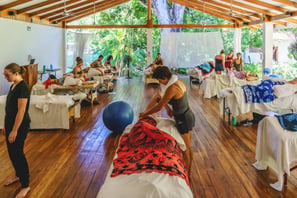
CRSMT is an accelerated, COMTA-accredited massage therapy certification program based in Sámara, Costa Rica, designed to be completed in 16 to 20 weeks. It includes small cohort sizes, an on-campus student clinic, hands-on training, and preparation for U.S. licensure pathways.
For Rojas, the immersive nature of the experience was essential.
“I moved (to Costa Rica). I lived there. I met a ton of new people,” she says. “I removed myself from my current life to know exactly how the body works, how energy works, because that's also a part of massage. I learned to interact with a totally different group of people that have different experiences.”
That kind of immersion, she insists, helped her embody the work she would later offer clients.
“(It helps you) to know what you like and what you don't like, and then how to see it or use it later in your career,” says Rojas, of the CRSMT curriculum. “It’s so ideal and helpful because I've seen people who have gone to other schools who miss that (immersive experience).”
Halpin points to the amount of hands-on time as one of CRSMT’s biggest differentiators, and the high standard it sets for those who enter the industry. As he puts it, the question for prospective students is not only whether they want to become massage therapists, but what kind of therapist they aspire to be.
“Do you want to be a good massage therapist or do you want to be a great massage therapist?” he says, insisting that CRSMT helps students take their skills to that next level.
Attending CRSMT also allowed him to form important relationships and gain experiences that have continued shaping his career after graduation, including his internship with Rojas and the confidence to build his own practice
Your Massage Therapy Career Can Become What You Make It
So, where can massage therapists work?
They can work in spas, wellness centers, fitness facilities, private practices, clients’ homes, cruise lines, corporate offices, resorts and retreats, airlines, hospice care, community organizations, schools, and continuing education settings. Some build their own businesses. Some specialize in sports massage or therapeutic bodywork. Some teach. Some combine multiple paths into a career that is entirely their own.
The spa is one option. It is not the only option.
For prospective students, that can be an encouraging realization. Massage therapy is not a narrow career with one expected outcome. It is a flexible profession that can evolve with your interests, your strengths, and the kind of impact you want to have.
CRSMT’s massage therapy certification program is designed to help students begin that journey through immersive training, hands-on experience, and exposure to a range of modalities and career possibilities.
For students who are ready to explore where massage therapy can take them, CRSMT can be a powerful place to start.
Ready to take the first step into a new adventure?
.jpg?width=352&height=198&name=Thai%20Massage%20in%20Costa%20Rica%20(1).jpg)